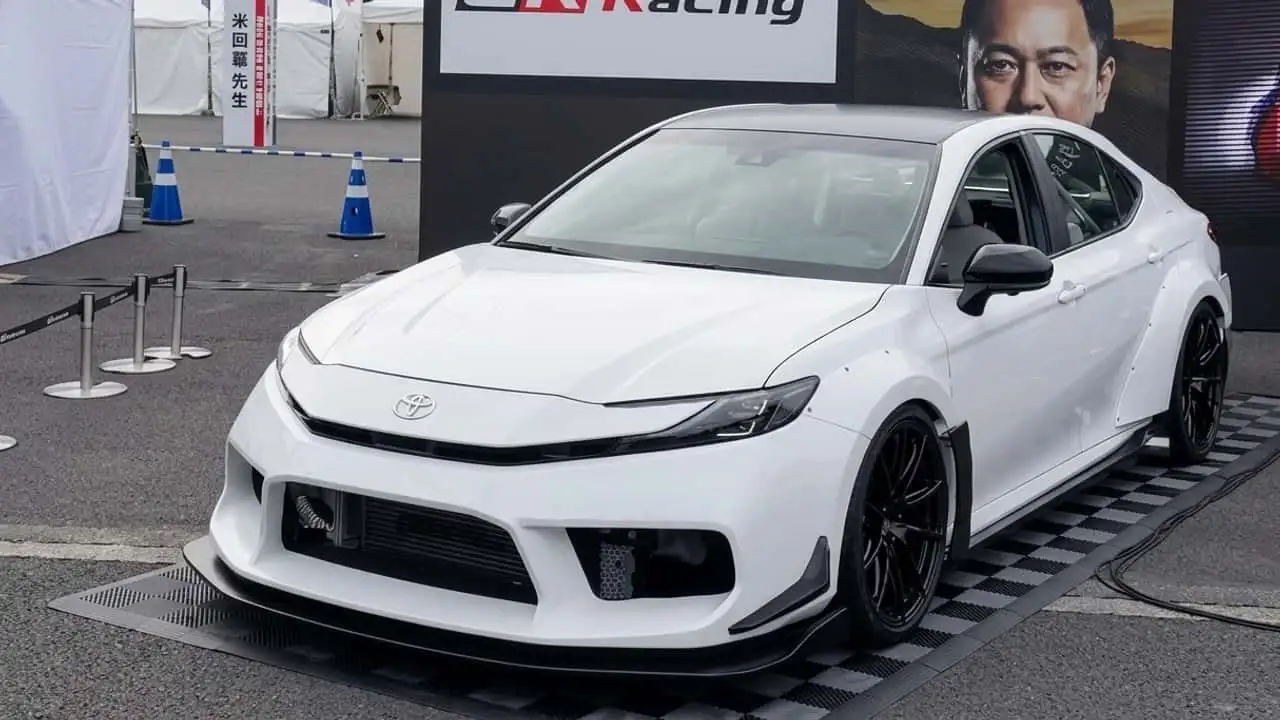
This past weekend’s 24-hour Super Taikyu endurance race became a showcase for Japanese automakers to experiment in public. Subaru previewed three upcoming production cars with manual transmissions, while Toyota and its Gazoo Racing division went in an entirely different direction—building a pair of radical Camry prototypes that exist purely as engineering showcases rather than future showroom models.
The more dramatic of the two Camrys features widened bodywork and an aggressive aerodynamic package, but its most surprising innovation is hidden underneath. Toyota’s Gazoo Racing engineers removed the stock four-cylinder engine and replaced it with a compact three-cylinder unit. On paper, that sounds like a step backward—but the engine in question is anything but ordinary.
The powerplant, known as the G16E-GTS, comes from performance-focused models such as the GR Yaris, GR Corolla, and Lexus LBX Morizo RR. In this configuration, it produces around 300 horsepower and drives the front wheels, instantly turning the Camry into a far more potent machine than any factory version of the sedan to date.
But the real twist lies at the rear. Where the back seats would normally sit, engineers installed a second engine: Toyota’s new turbocharged 2.0-liter four-cylinder, codenamed G20E, expected to underpin future performance models. In this setup, it delivers roughly 400 horsepower to the rear axle, effectively transforming the sedan into a dual-powertrain, all-wheel-drive experiment with an output approaching 700 horsepower.
The result is an unconventional engineering statement—an AWD Camry powered by two separate engines, connected through a side-exit exhaust layout and built purely for demonstration. Unsurprisingly, it will not reach production, joining the ranks of extreme one-off projects like the Volkswagen Scirocco Bi-Motor and Mercedes A38 AMG.
While Gazoo Racing explored the limits of dual-engine performance, another Toyota team revealed a second Camry concept with a completely different personality. This Bōsōzoku-inspired build features the same new four-cylinder engine up front but channels its power to the rear wheels through a manual gearbox, according to reports from Japan. The cabin, meanwhile, leans fully into theatrical excess, with a fur-covered dashboard, a glass shift knob, cigars, and even a chandelier completing the over-the-top interior theme.
Despite its show-car status, the second build reinforces Toyota’s willingness to experiment with both engineering and design extremes during motorsport events. Neither version of the Camry is intended for production, but both highlight the company’s broader exploration of new performance hardware and future engine development.
There is, however, growing speculation that the 400-horsepower G20E engine could eventually find its way into future performance models, including the long-anticipated return of the Toyota Celica. Toyota has also hinted at reviving the Toyota MR2 and confirmed development of a next-generation Toyota Supra, suggesting that while these Camry prototypes may be pure fantasy, the technology behind them could still shape the brand’s next generation of sports cars.